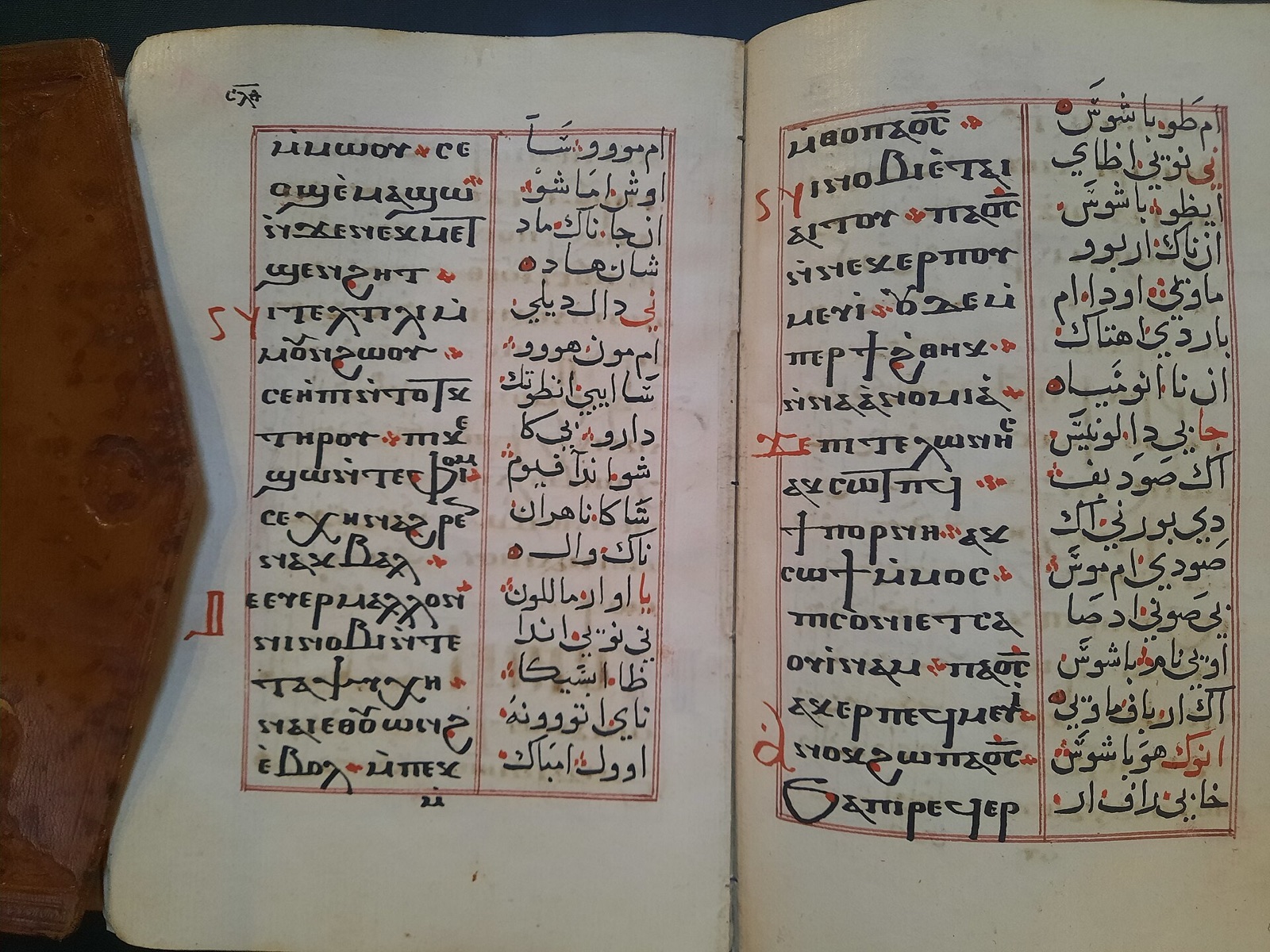
Egyptian museums preserve writing in several languages, scripts and media. Following them across time reveals changing institutions and readers, but only when text remains attached to its physical support and social setting.
Read placement before translation
Find where writing sits on the object: around a vessel, beside a figure, across a page or above an architectural opening. Scale and direction determine how closely a reader must approach. A text placed in a restricted sacred setting addressed a different audience from an administrative document or portable book.
Treat the support as technology
Stone, ceramic, wood, papyrus, parchment, paper, textile and metal require different preparation and tools. A manuscript combines support, ink, ruling, correction, binding and page sequence. A translation communicates words but cannot replace size, rhythm, margins or traces of handling.
Compare scripts without inventing a smooth line
Hieroglyphic, Greek, Coptic and Arabic writing belong to overlapping but distinct communities and institutions. Do not describe one script as simply turning into another. Compare dates, languages, functions and readers while noticing where practices coexist or where a new support changes the act of writing.
Look for multilingual evidence
Several languages or scripts on one object may reveal administration, devotion, translation or later reuse. Identify whether they were added together or at different moments. Alignment, ink, depth and surface can suggest sequence, but label evidence should guide interpretation.
Follow correction, damage and reuse
Writing carries a history after the first inscription. A scraped surface, overwritten line, patched page or recut name can indicate correction, economy, changing authority or reuse. Damage also matters: missing edges may remove the part that identified a person or date. Record what is absent before reading a museum translation as a complete voice. Conserved fragments often preserve several moments of writing rather than one finished statement.
Ask who could encounter the text
Literacy is not a simple divide between readers and non-readers. A monumental inscription could work through scale, image and public performance; a document might be read aloud or handled by specialists; a liturgical page belonged to repeated communal practice. Distinguish the person who composed, wrote, commissioned, displayed, recited and viewed a text. Museums often place all these roles behind the single modern label “inscription.”
Make titles relational
A translated title connects a named person with a temple, household, workshop or office. Ask what institution the title makes visible. Names are not only identification; they can establish memory, authority, dedication and family relationships. The unnamed makers and users remain part of the material history.
Use specialist collections
The Coptic Museum makes manuscript, textile and architectural writing central. The Museum of Islamic Art lets calligraphy be compared across book, ceramic, metal and building surface. NMEC can place language change inside a broader civilization sequence. Each expands what counts as Egyptian written culture.
Follow the sequence of looking
Do not begin every written object with the translation panel. First note where your eye enters, whether image and text share a direction, and whether repeated signs organize the surface. Then read the translation and return to the object. This order makes clear which claims come from your observation and which depend on specialist knowledge. It also prevents an English paragraph from replacing the designed experience of an inscription or page.
Read the museum label as another layer
Modern labels select a translation, date and interpretation. Cautious terms such as “probably” and “attributed” preserve uncertainty. Compare what you observed physically with what the label explains, and note which part of the inscription's history remains outside the short text.
Sources reviewed 28 July 2026: Coptic Museum ↗ · Museum of Islamic Art ↗ · NMEC ↗. Displays and visitor conditions may change.