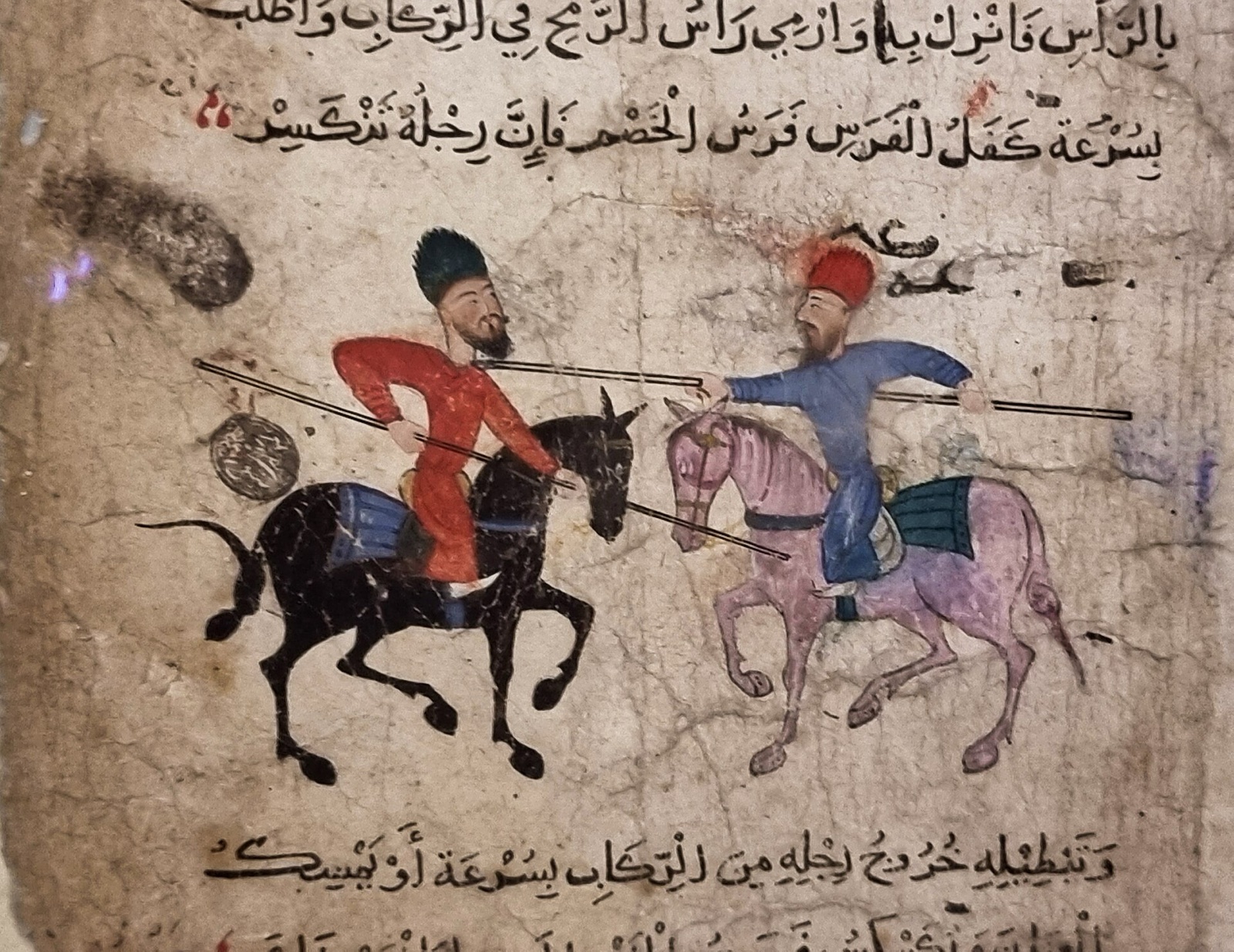
Islamic art and modern civilization displays reveal Egypt inside wider networks of language, craft, devotion, empire, reform and urban change. They should not be treated as a short epilogue after ancient galleries.
Begin with technique rather than a single style
Metal inlay, ceramic surface, carved wood, glass, textile and manuscript each carry regional workshop knowledge. Similar functions can produce different forms. Follow one medium across dates and places before assigning every object to one unified “Islamic” appearance.
Map networks through material
Cairo connects Africa, the Mediterranean, the Middle East and Asia. Ask whether materials and techniques were local, imported, adapted or repaired. Exchange is visible through process and provenance, not only motifs that look foreign to a modern viewer.
Keep writing physical
Calligraphy on architecture, ceramic, metal and manuscript guides viewing at different scales. A page requires closeness and sequence; a building inscription organizes movement. Compare support, margin, direction and color even when translation is unavailable.
Read period categories critically
“Islamic,” “Ottoman” and “modern” cover long and internally diverse histories. Check dates, places, patrons and function. Continuity inside a category can be as important as change at its border. Museum clarity should not become a claim that every transition occurred at once.
Follow patronage without losing the workshop
A ruler's, official's or foundation's name may explain why an object was commissioned, but not every technical decision. Separate patron, designer, maker, later owner and modern collector when labels allow. Repeated emblems and inscriptions can express authority; tool marks and joins recover the work that made that expression possible. Objects without a named patron still belong to economic and institutional histories.
Look for circulation after manufacture
Portable books, textiles, vessels and metalwork may travel through gift, trade, inheritance, endowment, reuse or the art market. The place of production, use, discovery and museum acquisition may all differ. Listing those places in sequence prevents “Egyptian object” from becoming an unsupported claim that every stage happened in one city or workshop.
Use NMEC for synthesis
NMEC can connect work, technology, belief and daily life across a broad timeline. Its strength is the cross-period frame; its limitation is the depth possible for each specialist field. Use it before or after the Museum of Islamic Art to compare synthesis with material detail.
Let cities enter the object
Architectural fragments, manuscripts and domestic objects belong to neighborhoods, institutions and building histories. The museum may isolate a surface for study. Ask what urban relationship—workshop, mosque, school, palace, market or household—the display can recover.
Question the boundary between art and daily use
A decorated lamp, basin, textile or writing tool may now be displayed for visual quality, yet its form also answered practical, social or devotional needs. Look for wear, capacity, grip, suspension and traces of repair before treating it only as an artwork. Conversely, an ordinary function does not make design unimportant. Comparing use and ornament helps explain why some objects entered art museums while related working materials remained outside the collection.
Do not freeze modern culture
Objects presented as traditions can make living practices appear timeless. Look for dates, makers, users and adaptation. Modernity is not a final room where historical change stops; it is another contested layer shaped by institutions and communities.
Sources reviewed 28 July 2026: Museum of Islamic Art ↗ · NMEC ↗. Displays and visitor conditions may change.